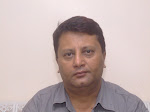
Today we are featuring a literary interview Sunil Sharma [right] did with the celebrated Pakistani-Parsi-American writer Bapsi Sidhwa [left] about culture, society, art and the craft of fiction-writing. In the words of Sunil Sharma, "The brilliant mind of the writer is summed up in this long dialogue, just beautiful, perceptive and crystal-clear." Sharma is an Indian associate-professor, freelance journalist and writer. Here he is in conversation with a senior author whose works have been made into cinema by the internationally-known Indian director Deepa Mehta.
[Please note that the series of 2010 readings lists and interviews is still going on, but while waiting for interview response, I thought you may enjoy this interview of an inspiring writer].
The Interview: Sunil Sharma and Bapsi Sidhwa
Sharma: What does it mean to be Bapsi Sidhwa in a globalized and de-radicalized world of 2010, a world where literature, like culture, has been grossly commercialized?
Sidhwa: Globalization has its advantages. To be translated and read in several countries is immensely satisfying; after all a writer - this writer at least - is driven by the impulse to communicate. Conversely, globalization exposes one to wonderful writers from diverse cultures. I am wary of best-sellers though – they are often predictable and padded with clichés and tawdry writing and don’t credit their readers with intelligence. Though in the age of twitter and texting the novel might shrink or evolve in unpredictable ways.
Sh: Who do you think you are finally? A Punjabi-Parsi –Pakistani? Or, a successful woman novelist from South-Asia, settled in America with a businessman husband?
S: In America I am a South Asian woman novelist. My other identities are of little consequence to anyone but me.
Sh: Are identities based on geography, religion, language and gender relevant in a post-modern world of micro-narratives and commoditized world of instant gratification?
S: Identities based on geography, religion, language and gender are as relevant in the post modern world as in the past or in the foreseeable future.
Sh: What is the role of a writer in such a culture of forgetfulness? Where brands compete and replace each other? Everything is instant and replaceable? Does word have any sanctity?
S: Writer’s narratives are woven into the fabric of life and history – it makes people aware of where they stand in relation to each other and the rest of the world. The word, as we understand it, may mutate, but it will always count.
Sh: Do you see any improvement in the situation for the female writers of English in Muslim – dominated Pakistan?
S: There is a tendency to marginalize female writers everywhere; although this tendency has become alarmingly noticeable in Pakistan of late.
Sh: Has the condition of the Pakistani Bride changed over the last few decades there?
S: The condition of the Pakistani Bride and of the tribal culture, in which her story unfolds in the novel, remains much the same in the remote mountain regions.
Sh: You said once that you felt limited in the Pakistani milieu and to overcome the restricted environment, decided to write. Settled in America for more than two decades, do you feel the same?
S:There are so many reasons why I took to writing. Ironically, the restrictive environment created a tension that was conducive to writing - but mostly I wrote to fill the silences in my earlier life. There can be too many distractions in the US.
Sh: Any homology between the trend-setter Crow Eaters and Mistry’s Such a Long Journey? A possible influence of your book and style over the latter’s novel?
S:There was a small outcrop of Parsi writers about 10 years after I wrote the Crow Eaters. A couple of them told me they had not thought Parsis could be written about in fiction until they read the Crow Eaters.
Sh: Are there better opportunities available for the South-Asian Writers now?
S: There certainly are – There are more publishing houses in SA and SA writing has become much more salable in the west as well. Our books are taught in universities and high schools in America and England and elsewhere.
Sh: Urdu has produced a long line of marvellous female writers but very few are there in English. Reasons?
S: There are quite a few good women writers who don’t get the break male writers writing in English get. I’m thinking of Bina Shah in particular – a prolific and excellent writer who does not have the recognition she deserves. There are many more critics and commentators where Urdu writing is concerned and they give women writers their due. Of course the pool of English writers is miniscule comparatively.
Sh: Your take on Pakistan’s writing in English?
S: It has made fair strides of late and Pakistani writers are becoming more confident.
Sh: Is writer relevant today?
S: Yes, writers are still popularly read because they reflect their societies and humans remain curious about other people and the drama of their lives. Writers are this era’ myth makers.
Sh: Pakistan is in flux. Religious fervor and Islamist forces are back. Have you any plans to document this socio-cultural upheaval, turmoil?
S: I have written about it in some essays. If it comes about naturally, I will write about it. So far I’ve been content to read journalistic accounts about the subject and they are having a field day with it.
Sh: Advice to a young writer? Do you mentor young voices as a senior writer?
S:I taught creative writing in several Universities in the US and have recommended promising manuscripts to publishers and agents. My advice to anyone who wishes to write, regardless of age, is to plunge into it. The more you think about it the less you will write. Degrees in English Lit inhibit one’s own writing. A lot depends on how driven a person is and the innate gift one has.
Sh: Most of the South Asian writing is clichéd and stereotyped. It is pandering to the persistent Western perceptions only. Regional- language literatures are more authentic. Do you agree?
S: I’m afraid much of Western writing is also clichéd and stereotyped. You are right though; some SA writers tend to make their work exotic to fit the preconceived notions the West has about us. In that respect Regional language work is more authentic – they don’t have to impress outsiders. They wouldn’t get away with distortions and false notes about their milieu.
Sh: After Pakistani Bride, larger women’s issues got neglected in your works. Their silence could not be kindly articulated as it was done in your first novel. Your Comment?
S: If I have a story to tell, I tell it as it comes naturally. My sympathy for women’s issues is deeply embedded in all my work – as much in An American Brat as it is in Cracking India/Ice-candy-man.
Sh: Why do Asian, African and Latin-American authors focus on backwardness of their societies in their English works for the purely Western and white- only audiences?
S: Stereotyping and reinforcing preconceived ideas about these countries makes the Western reader feel they are being fed the authentic stuff.
Sh: Any new work coming up for your fans?
S: A collection of short stories and essays is with my agent.
Sh: Your take on the film-literature interface? Is it a satisfying experience for the writer? Is it a bilateral creative process? Are film and literary idioms identical? Are you happy with the film version of your novel?
S: I found it satisfying – I was delighted and grateful that Deepa Mehta wanted to turn my book Cracking India into a film. It was a bilateral creative process for both of us and I’m happy with the result.
Sh: Can arts and literatures bridge political and religious divides of minds, especially in South Asia and Middle East?
S: They have done so in several instances and many valiant writers strive to do so despite the deepening animosities.
Bapsi Sidhwa is an award winning Pakistani novelist striving above all to bring women's issues of the Indian subcontinent into public discussion.
Internationally acclaimed author Bapsi Sidhwa was raised in Lahore, Pakistan. She now lives in Houston, Texas. She graduated from Kinnaird College for Women, Lahore. Her 5 novels: Cracking India, The Pakistani Bride, The Crow Eaters, An American Brat, and Water, have been translated and published in several languages. Her anthology City of Sin and Splendour: Writings on Lahore was published in 2006.Among her many honors Sidhwa received the Bunting Fellowship at Radcliffe/Harvard, the Lila Wallace-Reader's Digest Writer's Award, the Sitara-i-Imtiaz, Pakistan's highest national honor in the arts, and the LiBeraturepreis in Germany and the 2007 Primo Mondello Award in Italy.
Sidhwa, who was on the advisory committee to Prime Minister Benazir Bhutto on Women's Development has taught at Columbia U, University of Houston, Mount Holyoke College, Southampton University and Brandeis. Cracking India (a New York Times Notable Book of the Year and a Quality Paperback Book Club selection), was made into the film Earth by Canadian director Deepa Mehta. Her novel Water is based on Mehta’s film of the same name. Sidhwa’s play, An American Brat, was produced by Stages Repertory Theater in Houston March 2007. It played to full houses and received critical acclaim. Her play, Sock ’em With Honey, played in London in 2003.
Sunil Sharma is associate professor, vice-principal and head of department of English, Model College, which is affiliated to the University of Mumbai, India. He is a bilingual critic, poet, literary interviewer, editor, translator, essayist and fiction writer. Some of his short stories and poems have already appeared, among others, in prestigious journals like: Hudson View (South Africa), Munyori, The Plebian Rag and the Bicycle Review (all three USA e-zines), New Woman (Mumbai); Creative Saplings, Muse India and Kritya (both Indian e-zines); the Seva Bharati Journal of English Studies(West Bengal), Indian Literature (of Sahitya Akademy, New Delhi), Laybrinth (Gwalior), Indian Literary Panorama (Mumbai), Contemporary Vibes (Chandigarh), Indian Journal of Post-colonial Literatures(Kerala), Poets International and Prosopisia (Ajmer). Some of his poems and shorts have been anthologized in national and international collections. Besides that, he is a freelance journalist in English. His areas of strength are Marxism, Literary Theory and Cultural Studies. His book on the Philosophy of the Novel—a Marxist Critique is already published and got a good response. His debut novel—The Minotaur—dealing with dominant ideologies and sociopolitical realities of the 20th century was also published from Jaipur (India) in 2009. The novel has been favourably received and reviewed. He has also edited, along with Dr Jaydeep Sarangi, an anthology of shorts, The Editors’ Chioce: Contemporary Short Stories in Indian English, published by Gnosis Publications, New Delhi, 2010. He is one of the editors for the NFJ (New Fiction Journal), an international journal devoted to the short stories. Also, joint secretary of GIEWEC (Guild of Indian English Writers, Editors and Critics). He serves on many advisory boards of quality international literary and online journals.